| dc.contributor.author | Saklamaz, Selin | |
| dc.contributor.author | Akpınar, Havva | |
| dc.date.accessioned | 2026-06-23T11:42:58Z | |
| dc.date.available | 2026-06-23T11:42:58Z | |
| dc.date.issued | 2026 | en_US |
| dc.identifier.citation | Saklamaz, S.; Akpınar, H. Relationships Among Cognitive Distortions, Forgiveness of Others, and Self-Forgiveness in Psychiatric Outpatients with Depressive Disorders: A Cross-Sectional Study. Healthcare 2026, 14, 1478. https://doi.org/10.3390/healthcare14111478 | en_US |
| dc.identifier.uri | https://doi.org/10.3390/healthcare14111478 | |
| dc.identifier.uri | https://hdl.handle.net/20.500.12809/11212 | |
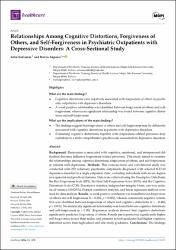
| dc.description.abstract | Background: Depression is associated with cognitive, emotional, and interpersonal difficulties that may influence forgiveness-related processes. This study aimed to examine the relationships among cognitive distortions, forgiveness of others, and self-forgiveness in patients with depression. Methods: This cross-sectional and correlational study was conducted with 252 voluntary psychiatric outpatients diagnosed with selected ICD-10 depressive disorders in a single outpatient clinic, excluding individuals with severe depressive episodes and psychotic features. Data were collected using the Descriptive Data Form, the Rye Forgiveness Scale (RFS), the State Self-Forgiveness Scale (SSFS), and the Cognitive Distortions Scale (CDS). Descriptive statistics, independent-samples t-tests, one-way analysis of variance (ANOVA), Pearson correlation analyses, and linear regression analyses were used for data analysis. Results: A weak positive correlation was found between forgiveness of others and self-forgiveness (r = 0.206, p < 0.001), whereas a moderate negative correlation was identified between forgiveness of others and cognitive distortions (r = −0.486, p < 0.001). No statistically significant relationship was found between cognitive distortions and self-forgiveness (p > 0.05). Regression analysis showed that cognitive distortions significantly predicted forgiveness of others. Female participants had significantly higher self-forgiveness scores than males, and primary school graduates had higher cognitive distortion scores than high school and university graduates. Conclusions: The findings suggest that cognitive distortions may be more strongly associated with forgiveness of others than with self-forgiveness in psychiatric outpatients with depressive disorders. Further longitudinal and intervention-based studies are needed to better clarify these relationships. | en_US |
| dc.language.iso | eng | en_US |
| dc.publisher | MDPI | en_US |
| dc.relation.isversionof | 10.3390/healthcare14111478 | en_US |
| dc.rights | info:eu-repo/semantics/openAccess | en_US |
| dc.subject | depressive disorder | en_US |
| dc.subject | cognitive distortions | en_US |
| dc.subject | forgiveness of others | en_US |
| dc.subject | self-forgiveness | en_US |
| dc.subject | psychiatric outpatients | en_US |
| dc.title | Relationships Among Cognitive Distortions, Forgiveness of Others, and Self-Forgiveness in Psychiatric Outpatients with Depressive Disorders: A Cross-Sectional Study | en_US |
| dc.type | article | en_US |
| dc.contributor.department | MÜ, Sağlık Bilimleri Fakültesi, Hemşirelik Bölümü | en_US |
| dc.contributor.authorID | 0000-0002-6309-8135 | en_US |
| dc.contributor.institutionauthor | Saklamaz, Selin | |
| dc.contributor.institutionauthor | Akpınar, Havva | |
| dc.identifier.volume | 11 | en_US |
| dc.identifier.issue | 14 | en_US |
| dc.identifier.startpage | 1478 | en_US |
| dc.relation.journal | HEALTHCARE | en_US |
| dc.relation.publicationcategory | Makale - Uluslararası Hakemli Dergi - Kurum Öğretim Elemanı | en_US |