| dc.contributor.author | Dinç, Ahmet | |
| dc.contributor.author | Toğay, Yeşim | |
| dc.date.accessioned | 2026-06-23T13:54:43Z | |
| dc.date.available | 2026-06-23T13:54:43Z | |
| dc.date.issued | 2026 | en_US |
| dc.identifier.citation | Dinç, Ahmet et al. "Effects of Vermicompost and Microbial Fertilizers on Yield and Quality Traits of Chickpea (Cicer arietinum L.)." Polish Journal of Environmental Studies, 2026. doi:10.15244/pjoes/218833. | en_US |
| dc.identifier.uri | https://doi.org/10.15244/pjoes/218833 | |
| dc.identifier.uri | https://hdl.handle.net/20.500.12809/11218 | |
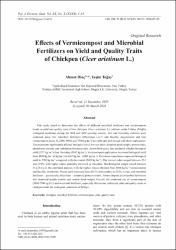
| dc.description.abstract | This study aimed to determine the effects of different microbial fertilizers and vermicompost levels on yield and quality traits of two chickpea (Cicer arietinum L.) cultivars under Fethiye (Mu & gbreve;la) ecological conditions during the 2018 and 2019 growing seasons. & Idot;nci and Hasanbey cultivars were evaluated using two microbial fertilizers (Rhizobium ciceri and Bacillus megaterium) and four vermicompost doses (0, 2500, 5000, and 7500 kg ha-1) in a split-split plot design with three replications. The treatments significantly affected biological yield, harvest index, hundred-grain weight, protein ratio, phosphorus content, and nodulation characteristics. Across both years, & Idot;nci produced a higher biological yield (5757 kg ha-1) than Hasanbey (5542 kg ha-1). Vermicompost applications increased biological yield from 4994 kg ha-1 (0 kg ha-1) to 6167 kg ha-1 (5000 kg ha-1). Rhizobium inoculation improved biological yield to 5781 kg ha-1 compared with the control (5419 kg ha-1). The harvest index ranged between 25.1 and 27.9%, with higher values generally observed in Hasanbey. Hundred-grain weight varied between 37.2-38.5 g in the combined analysis, with the highest values obtained from 5000 kg ha-1 vermicompost and Bacillus treatments. Protein ratio increased from 20.3% in Hasanbey to 21.1% in & Idot;nci, and microbial fertilizers-particularly Rhizobium-enhanced protein content. Vermicompost and microbial fertilizers also improved nodule number and nodule fresh weight. Overall, the combined use of vermicompost (5000-7500 kg ha-1) and microbial fertilizers, especially Rhizobium, enhanced yield and quality traits in chickpea under the ecological conditions of Fethiye. | en_US |
| dc.language.iso | eng | en_US |
| dc.publisher | HARD | en_US |
| dc.relation.isversionof | 10.15244/pjoes/218833 | en_US |
| dc.rights | info:eu-repo/semantics/openAccess | en_US |
| dc.subject | chickpea | en_US |
| dc.subject | microbial fertilizer | en_US |
| dc.subject | vermicompost | en_US |
| dc.subject | yield | en_US |
| dc.subject | quality traits | en_US |
| dc.title | Effects of Vermicompost and Microbial Fertilizers on Yield and Quality Traits of Chickpea (Cicer arietinum L.) | en_US |
| dc.type | article | en_US |
| dc.contributor.department | MÜ, Fethiye Ali Sıtkı Mefharet Koçman Meslek Yüksekokulu, Bitkisel Ve Hayvansal Üretim Bölümü | en_US |
| dc.contributor.authorID | 0000-0001-5285-1083 | en_US |
| dc.contributor.institutionauthor | Toğay, Yeşim | |
| dc.identifier.volume | 20 | en_US |
| dc.identifier.issue | 10 | en_US |
| dc.identifier.startpage | 1 | en_US |
| dc.identifier.endpage | 14 | en_US |
| dc.relation.journal | POLISH JOURNAL OF ENVIRONMENTAL STUDIES | en_US |
| dc.relation.publicationcategory | Makale - Uluslararası Hakemli Dergi - Kurum Öğretim Elemanı | en_US |