| dc.contributor.author | Dereköylü, Engin | |
| dc.contributor.author | Çoşkun, Çağrı | |
| dc.contributor.author | Aydın, Uğur | |
| dc.contributor.author | Tarım, Kayhan | |
| dc.date.accessioned | 2026-06-26T12:47:36Z | |
| dc.date.available | 2026-06-26T12:47:36Z | |
| dc.date.issued | 2026 | en_US |
| dc.identifier.citation | Coşkun Ç, Aydın U, Tarım K, Dereköylü E. Is the Prognostic Nutritional Index a Predictor of Urolithiasis?. J Urol Surg. 2026 Jun 1;13(2):108-113. doi: 10.4274/jus.galenos.2025.2025-8-1. Epub 2026 Mar 16. | en_US |
| dc.identifier.uri | https://hdl.handle.net/20.500.12809/11238 | |
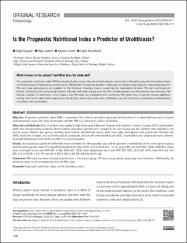
| dc.description.abstract | Objective: Prognostic nutritional index (PNI) is a parameter that reflects nutritional status and inflammation. It is calculated from serum albumin and lymphocyte count. Our study investigated whether PNI has a predictive value in urolithiasis. Materials and Methods: Data of patients who applied to A & gbreve;r & imath; Training and Research Hospital with renal colic between January 2017 and December 2024 were retrospectively examined. Three hundred forty-eight patients were included in the stone group and 627 patients were included in the control group. Patients' age, gender, smoking, hypertension, and diabetes history, body mass index, hemoglobin level, glomerular filtration rate (GFR), blood urea nitrogen, uric acid levels, sodium, potassium, calcium, white blood cell count (WBC), neutrophil count, lymphocyte count, albumin, neutrophil/lymphocyte ratio (NLR), and PNI levels were compared. Results: No statistically significant difference existed between the demographic data and the patients' comorbidities. In the stone patients group and the control group, mean GFR was 88.04 [standard deviation (SD): 13.21], 93.90 (SD: 13.17); mean WBC was 8910 (SD: 1629), 8268 (SD: 1562); mean neutrophil count was 6040 (SD: 1416), 4933 (SD: 1283); mean lymphocyte count was 2070 (SD: 879), 2535 (SD: 944); mean NLR was 3.62 (SD: 2.1), 2.34 (SD: 1.41); PNI was 30.73 (SD: 6.85), 53.66 (SD: 6.94) (p<0.001, all). Conclusion: PNI value was lower in stone patients than in the control group. PNI may be a parameter predicting stone formation. Additionally, the predictive value can be strengthened with the NLR value. | en_US |
| dc.language.iso | eng | en_US |
| dc.publisher | GALENOS PUBL HOUSE | en_US |
| dc.relation.isversionof | 10.4274/jus.galenos.2025.2025-8-1 | en_US |
| dc.rights | info:eu-repo/semantics/openAccess | en_US |
| dc.subject | Prognostic nutritional index | en_US |
| dc.subject | urolithiasis | en_US |
| dc.subject | kidney stone | en_US |
| dc.title | Is the Prognostic Nutritional Index a Predictor of Urolithiasis? | en_US |
| dc.type | article | en_US |
| dc.contributor.department | MÜ, Tıp Fakültesi, Cerrahi Tıp Bilimleri Bölümü | en_US |
| dc.contributor.authorID | 0000-0001-7580-0967 | en_US |
| dc.contributor.institutionauthor | Dereköylü, Engin | |
| dc.identifier.volume | 13 | en_US |
| dc.identifier.issue | 2 | en_US |
| dc.identifier.startpage | 108 | en_US |
| dc.identifier.endpage | 113 | en_US |
| dc.relation.journal | JOURNAL OF UROLOGICAL SURGERY | en_US |
| dc.relation.publicationcategory | Makale - Uluslararası Hakemli Dergi - Kurum Öğretim Elemanı | en_US |